Ryan Lee Art
Illustration, Concept Art, Fine Art, Painting, Drawing, Sketching. Portfolio Website: www.ryanleeart.com
Friday
Spectrum Live!!!
The time has arrived! Spectrum Fantastic Art Live is happening this weekend in Kansas City, MO--and chances are, if you've been following this blog you already know what it is and what its all about! This is the Second year for the SFAL event and is sure to be even bigger and better than last time around. I had a great time, met lots of amazing folk, and bought a ton of gorgeous artwork from some of my favorite talents. Time to do it all again! Anyway, I'm just about all packed and ready to head over there and plan to arrive Friday afternoon if the weather cooperates. I'll be exhibiting at the Muddy Colors booth this year and will be bringing some goodies for sale. Very limited custom prints will be available at ridiculously low prices, as well as cards and personalized sketches, aaand there are two other surprises that will be on display for a short time. If you will be in attendance this year, drop by and say hello!
Thursday
WHOA
Humbled beyond belief at being chosen to exhibit with the Muddy Colors folks, whose work and wisdom I've been following since I first heard about their collective a few years ago. Still processing the whole thing at this point, and I think it's going to take a few days to wrap my head around it. Humongous thanks to Dan Dos Santos and the other judges over at the Muddy Colors blog, as well as a big congratulations to Kim Kincaid, Liz Pulido, and Mia Arujo with whom I share this victory. Can't wait until the Spectrum Live 2 event in Kansas City (May 17-19), where you'll likely find me giggling like a little girl by the posters and prints. Don't miss it, last year was an incredible time, and this one is sure to be even better! Hope to see you all there!!
Sunday
"The Guarded"
Thursday
The Guardian
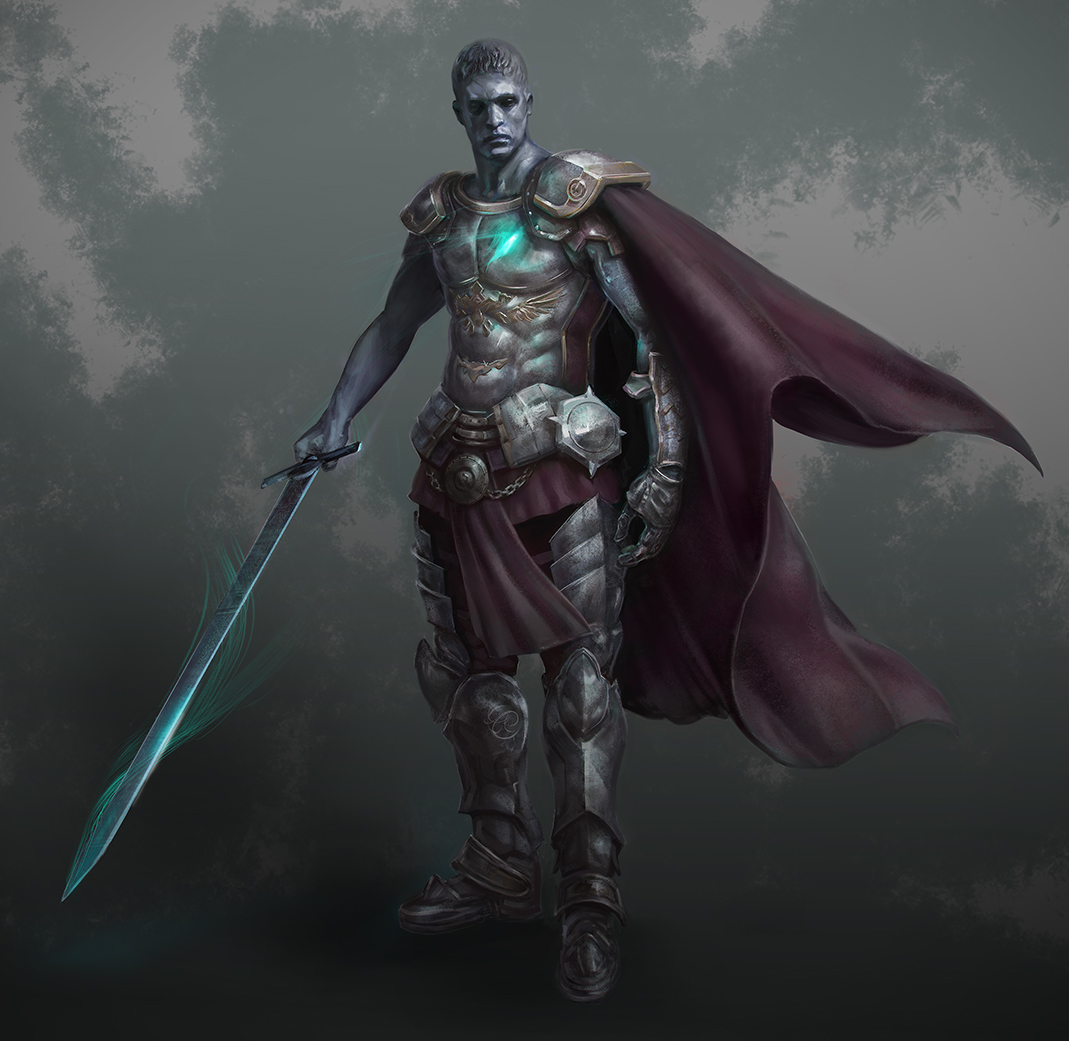
"King Dynanon", Photoshop, March 2013. Building a castle...one stone at a time. ;)
Oh!--and here's a little teaser of something on the way.. Thanks for stopping by!
Sunday
Imagine FX Write-Up!
Hey everyone! I was recently asked to do a breakdown for the April 2013 issue of Imagine FX covering my recent submission the Art Order Challenge. The issue hit stores only a few days ago, and is loaded with a lot of really great content, so go grab a copy and check it out! Here's a link to more info on the issue and some of the other great articles it will be featuring: http://beta.imaginefx.com/shop/magazine/april-2013
Really grateful to Ian Dean and Nicola Henderson at FutureNet for setting up the opportunity.
Monday
The Dark Tower
Been itching to do some Dark Tower artwork for a while now. Finally got around to "imagineering" a portrait of Roland based on a collage of actors I think embody his character and likeness from the book. Calling this one a warm-up for now, I think I've got another one or two in me before I finish reading the series... :)
Wednesday
Infected By Art!
Hey, I just learned about a really cool project/contest happening called Infected By Art! I entered in one of my newest piece for the jury. If you have a moment, please follow the link below and vote for "Until I Say"! I will buy you flowers and send you a box of chocolates if I get enough votes from you! :B
LINK: https://infectedbyart.com/entries/880#.UQmacSfAdFY
Tuesday
Best In Show!
Woohoo!! "Until I Say" just won the Institutional category and Best In Show over on the Art Order Blog ( http://theartorder.com/the-artorder-nymp-challenge-judging/ ). I want to extend a huge thanks to all of the judges: Chris Moeller, Daren Bader, Jeremy Cranford, Lauren Panepinto, Tony DiTerlizzi, and of course, Jon Schindette!--Also, thanks to everyone who managed to pass a vote over on the Facebook page. I appreciate all the love and support from everyone--January's been a good one!
Thursday
Daughters of Boreas
Here's my second entry for the Art Order Nymph Challenge coming up next week. It is my sincerest hope that this painting gives the viewer the sense that these floating cloud women smell like the finest laundry detergent/dryer sheets in existence. If not, I'll have to try harder next time. But in all seriousness, thank you for stopping by--wish me luck for the Nymph Challenge and have a sweet weekend!! :P
Tuesday
Almost ready!
New website is almost done--just a few more tweaks! Here's the latest from studio Ryan! Happy 2013 everyone! Cheers!
Friday
Maintenance..
Touching up a few things in preparation for the launch of a brand new website. Details to come soon!
Wednesday
Friday
Thursday
Moleskine!
A sneak peak of my sketch for the Moleskine Project, coming to Spoke Art Gallery, SF-CA this december! So excited to be part of this monster line-up of artists!! It is certain to be a CRAZY show, please try and make it if you're going to be in the area!!!
Wednesday
Process & Techniques: Shapes (Part II)
On Seeing Shapes:
You can render all day long and make
the smoothest drawing anyone has ever seen, but if your proportions
are wrong your work is still going to look like crap.
What is a
likeness without a face? Or a face without a likeness? Somewhere
between underwear streaks and old spaghetti, that's what. I'm being
harsh about this poor artists work, but it's okay because these are
my drawings from 9th grade.
You can fill sketchbook after
sketchbook and witness yourself get better gradually over time. Or
you can buckle down and do “Block-Ins” and give yourself
something that can count as muscle memory or more reflexive
knowledge. Block-Ins are pretty complex, and I know others who are
extremely qualified to speak on behalf of all the merits they entail, but I'm only going to cover a few things that I think are really important
and can be applied by you immediately.
- They make your brain work good.
...Well, for the most part. Block-Ins
are the best way to teach yourself how to quickly and accurately
“see” proportions and shapes for what they really are, separated
from all the little details your brain likes to focus on. One of the
most difficult things for an artist to do is capture a person's
likeness accurately for a portrait. The reason this is so difficult
is because nearly everyone's brain is hard-wired to see faces and
assign all this extra meaning and symbolism to it. This information
distracts the eye from acknowledging what it is truly looking at.
Block-ins are a great exercise to help you “abstract” objects and
not get lost in all the minutiae of what you're looking at. Being
able to see complicated things broken down into really simple or
crudely familiar shapes will grant you tremendous leaps with your
art. --AND most importantly, with faces.
2. They help you see things in a new
and exciting way. (Part of making your brain work gooder.)
Every morning when I hop into the
shower and begin the process of waking up, I stare into this
cacophony of marble chaos:
My eye is almost immediately drawn to
some shape or pattern that in my mind becomes something familiar.
Donald duck perhaps, a cow, maybe a palm tree. It isn't very
different from staring at clouds and “seeing” shapes.
But one
thing that is extremely difficult to do is to try this while looking
at someone's face. Never mind what they might think of you staring
at them like a creeper, but truly—if you were to take a cheekbone
and an ear and be able to see it isolated from the face, what would
it look like to you? Is an eye really an oval shape with a little
black dot at the center, or is that merely a cartoonish symbol we've latched onto? Or could an eye be something different entirely
from every angle? This is the train of thought one should
develop to help in this area of drawing or portraiture. It is
extremely valuable to be able to discard a face's symbolism for its
geography instead. A Drama professor I once had made it a point to
have everyone in class understand that a person's face is an
environment, with all of its nooks, and hills, and sharp or soft
angles. He was discussing it in the context of film and the stage,
but it still applies here quite well. This is a good way to approach
one of the core understandings of seeing shapes accurately.
Of course, this all doesn't just apply
to faces. But I do believe as one who struggled with human
portraiture for a long time, that once you are able to
confidently construct a person's face using graphite or paint, you
won't find much difficulty in accurately and proportionately
depicting much else. It always comes down to focusing on the big
shapes first. The wonder and success of your art won't be sewn in
the details, but rather the foundations you lay first.
3.They make you faster.
This isn't the most important benefit,
but I thought I should include it because it never hurts to be able
to do your work well and quickly without sacrificing quality.
Block-Ins will familiarize you with your tools. They will also
familiarize you with a new kind of dexterity. You will get so used
to making all manner of pencil marks all of the time that you will
begin to develop a certain confidence and short-hand for drawing
things quickly. Block-Ins will break your comfort zones so that you
wont find yourself settling into that same contour or that same oval
you've always used to draw someone's torso. Ironically, Block-Ins
will also free you from a reliance on line-making altogether. Once
you start to think in shapes rather than lines, you'll begin to do
things that might impress you. Lines have their place of course, but
all too often they can become a crutch to students who are far too
myopic in their attempts to construct an anatomically correct
skeleton for their work.
Okay, so now begs the question, “What
IS a Block-In?”
Now there are many variations in one's
approach to drawing something, and many, many roads to get there.
I've heard of something called a “Sight/Size” method for
understanding shapes which involves as I understand it, setting up
your workspace next to the object of your affection and trying to
“clone” said object in every way that you can. Once your work is
drawn at the same size and proportion and color or value of the
object, you have successfully attempted a “Sight/Size” way of
doing things.
There is also what is called the
envelope method, which is as far as I know, basically another term
for the Block-In. An Artist here approximates the shape of the
object they wish to depict with as few lines as possible, "enveloping" what will be the space their drawing will occupy. From
there the artist begins to chisel away at that shape, gradually increasing the
level of mark making at each pass until it begins to form a a crude
but accurate model of the object. During this process it is of the
utmost importance that an artist is checking their work each step of
the way. Abandon all delusion that you are going to nail it, and
achieve any sort of perfection. This exercise isn't really about the
end result at all. It is entirely about what you are training
yourself to do. It is about what you are training yourself to think.
Repetition, diversity of subjects, discipline, and preparation are all key to
creating successful Block-Ins. You need to prepare yourself to do a
lot of them, anticipating that you may well be doing them for as long
as you intend to pursue a career in the arts. You need a good
workspace, with plenty of room and easy access to your materials.
You need to make sure you are never drawing the same thing from the
same angle ever, unless you are coming back to something after a long
time to gauge your improvement. It is also crucial to sit still!
Moving your body's position even slightly while you are working on
this will have a highly detrimental effect on your work. Moving your
head an inch to the left, or twisting your hips to sit or stand more
comfortably could change the entire shape of the object you were
drawing or painting from the angle you were drawing or painting it!
So long as you are ever drawing anything from life or attempting to
achieve anything within the realm of realism, Block-Ins and/or
similar methods of understanding will be your ally.
For a fantastic visual example of a Block-In-Progress, there's a really quick write up over on the Safehouse Atelier blog: http://thesafehouseatelier.blogspot.com/2010/11/block-ins.html Now that you're all done reading, check that link! :)
Tuesday
Process & Techniques (Part I)
Okay. No art this time. We're going
to go over something different. I'm going to cover a bit of the
process & technique side of things this time around.
I've heard many an artist gripe about
fielding the question from those they deem uninitiated, “What kind of pencil do you use?” Some artists will wave this question off
as not being the right question to ask or somehow naive and insulting
all the hard work they did to become so “talented”. This really
shouldn't be the case. Sure, creating good and great art using a
pencil will require a lot of hard work, and time, and
blood/sweat/tears/blahblahblah --same as any other medium, but there's
nothing wrong with the honest question of asking an artist about
their favorite materials. Sometimes when you get an artist to start
rambling and meandering about such things, they reveal other
informative tidbits about their process and the things they've learned
along the path of their own artistic growth. I'm going to attempt to
induce this from myself in order to write up something that someone,
with hope, will find useful and/or interesting.
SO!--What kind of pencil do I use???
Glad you asked, I have a couple favorites:
The old 0.3mm. Usually comes in a
yellow lead holder, at least the ones I've always had. Be sure and
get a nice and fancy one. These suckers are life savers when it
comes to the fine details. I love
love LOVE to render my drawings. Turning
form with big broad strokes is all good and fine, but if you're
looking to manipulate the grain of your paper; to really dig in and
get that tiny reflection on the edge of that person's iris, or the
subtle gradation of a forearm, then you might consider messing with
one of these. They aren't as common as 0.5mm lead holders, so
finding the right refill lead can be a difficult task. For the
figure drawings I made while studying at the Safehouse Atelier, I
became very partial to F (Fine Point) lead for its ability to give me
a powerful value range while staying clean, sharp, and light--but not as weak as some H(Hardness) leads. I would work
lighter and save those dark areas for later, simply marking them off
so that I had a visual indicator of the range I was going to push
for. B (Blackness) lead and I have always had a tumultuous
relationship, so I won't go into that right now—but if you are
going to use it, play fast and loose—Embrace your inner
chiaroscuro, bro...or something. In all seriousness though, B's are,
as far as I tend to use them, best for larger fill areas where you
aren't looking to create a huge value shift. But I digress, for a
0.3mm lead holder, your best and most available friend will probably
be HB(Hardness/Blackness). HB is right there in the middle next to F
on the pencil range offering a bit more darkness. I do find HB to
feel the most like a ball point pen when using it. It has a tendency
to feel like its sliding across the paper on a pair of ice skates letting you maintain control as you make your stroke. F does that too, just not quite to the same effect. Why could
it be important for your pencil to feel like a ball point pen?
Confidence. You want your marks to look like you meant to make them.
Pen and ink is pretty permanent, and the bold lines you get within
that medium can be achieved in a pretty freaking spectacular way with
pencils too.
Obviously there are countless ways to
go about this, again I just want to restate that this is how I play
around with these materials and how they've best helped me in the
past. Everyone does their own dance when it comes to this stuff.
I'm also pretty fond of these:
The Sumo Grip is great for a few
reasons. Its the cheapest mechanical pencil I've been able to find
in art stores that isn't a total piece of crap, and for digital
artists it makes for a wonderful translator. It has almost the exact
same size and shape as the standard Wacom tablet stylus pens. An
invaluable asset for artists who frequently jump between mediums or
need to shift gears constantly between digital and traditional art. I've seen these run in 0.9mm and
0.5mm at Utrecht and Blicks. These sizes are very common so it
should be easy to find whatever lead type you need.
I use three different types of erasers
while I work in the sketchbook: A Tombo Mono-Zero Elastomer Eraser.
This is the little cousin of the more common TUFF STUFF Eraser Stick
found in most art stores. The little one is trickier to find, but it
does exist and it is wonderful in a pinch. For most mistakes and
special marks though, the kneaded eraser can be called upon. It is
easily the most versatile of the bunch. Also the easiest to lose in
your pocket or in the deepest depths of a backpack or messenger bag.
So here's a nice little opinion piece
where I talk about my favorite materials and muse about their
respective uses, but let's move over to something that I think an
aspiring artist will find really helpful. Next time, I'm going to talk about Shape and Proportion.
SHAPES!...to be continued tomorrow.
Sunday
Monday
Illustration!
A personal piece done in my spare time. It was difficult not to crack up laughing while painting the horse's face, but I managed to work through it. Also included a small step-by-step below it for anyone interested in the process.
"Need Help"
A short animation film project I made in college. Occasionally when you're digging through your old stuff, you find gems like this... I hope you enjoy!
Wednesday
Tuesday
Friday
Subscribe to:
Posts (Atom)